
After a cancer diagnosis, your next decision is not simply where to have surgery. You need a documented stage, the right specialists, a clear treatment sequence and a reliable plan for moving between local follow-up in Baramati and specialist care in Pune when necessary. By the end, you will know what to take, what to ask and how to organise care before and after an operation.
Key takeaways
- Carry biopsy reports, scans, medicine lists, and prior treatment records.
- Ask who coordinates surgery, chemotherapy, radiation, pathology, and follow-up.
- Choose local reviews for convenience and Pune referral access for complex care.
- Seek urgent help for heavy bleeding, breathing difficulty, fever, or sudden confusion.
Who coordinates care after a cancer diagnosis?
The treating cancer team—usually the lead cancer surgeon working with medical and radiation oncologists—coordinates care after diagnosis. A surgeon in Baramati can manage local reviews, while a cancer specialist in Pune handles complex surgery, specialist pathology, chemotherapy or radiation planning.
The next step comes from complete staging, not the first scan alone. Examination, biopsy pathology, CT or MRI, PET-CT when indicated, and endoscopy establish the cancer’s extent. The final plan may be surgery first, chemotherapy or radiotherapy before surgery, or treatment without immediate surgery.
A multidisciplinary review should include the relevant specialists:
- The pathologist confirms tumour type, grade, molecular findings, margins and lymph-node involvement.
- The radiologist checks whether imaging shows spread, vessel involvement or resectability.
- The surgeon assesses the operation, recovery demands and need for referral to Pune.
- Medical and radiation oncologists decide whether additional treatment comes before or after surgery.
- The coordinator gives you one written sequence, named contacts and the location for each appointment.
For cancer treatment in Baramati, ask who owns the overall plan and who responds between visits. The handoff should include reports, scan images, medication changes and agreed dates, not just a verbal referral.
After treatment, the Baramati team can handle wound checks, drains, nutrition and routine surveillance, while Pune provides tertiary review when the tumour or complication requires it.
How to choose a cancer surgeon in Baramati when surgery is only one part of treatment
Choose the team, not only the operator: a cancer surgeon in baramati should be judged by how the hospital manages the entire pathway. Compare the plan against your tumour type, stage and likely sequence, including whether chemotherapy or radiation comes before or after surgery. A multidisciplinary review is stronger than a surgeon’s opinion alone.
| Factor | What to compare | Why it matters |
|---|---|---|
| Tumour and operation | Experience with your cancer and proposed procedure; ask for the surgeon’s recent operation volume | Familiarity can affect planning, complication management and recovery |
| Hospital support | Specialist pathology review, anaesthesia, intensive care, blood bank, interventional radiology and emergency cover | These services matter when bleeding, leaks, infection or organ problems develop |
| Complete treatment | Named medical and radiation oncologists, tumour-board review and access to chemotherapy or radiotherapy | Surgery may be only one stage of treatment |
| Continuity | Wound checks, drain management, nutrition, symptom review and written escalation instructions | Follow-up must continue after discharge, not end at the incision |
For cancer treatment in baramati, local postoperative care and referral to Pune are complementary. A local surgeon can manage routine reviews while a Pune team provides specialist pathology, radiation, medical oncology or complex hepatopancreatobiliary surgery.
Before agreeing, ask:
- Who will coordinate treatment if the plan changes?
- Who manages a leak, infection or bleeding after discharge?
- Where will you go at night for breathlessness, confusion, heavy bleeding or worsening abdominal pain?
- Which doctor will review the final pathology and decide on further treatment?
If nobody gives clear names, phone numbers and an emergency location, the arrangement is incomplete.
What to take and ask at the first post-diagnosis appointment
Carry every record to your appointment with a cancer surgeon in Baramati, including the actual scan images rather than reports alone. Missing images or pathology details can force repeat testing and delay staging.
- Biopsy and histopathology reports, plus immunohistochemistry results
- CT, MRI or PET-CT images on a disc or secure link, with written reports
- Endoscopy or colonoscopy report, photographs and biopsy results
- Recent blood-test results, including liver and kidney function
- Discharge papers, referral letters and previous treatment records
- A current medicine list, including doses, allergies and supplements
- The tissue slides or paraffin block, if the hospital can release them for review
Ask these questions and write down the answers, including who will coordinate the next appointment.
| Question | What the answer should clarify |
|---|---|
| What is my exact clinical stage and treatment goal? | Whether surgery is primary treatment or part of a planned sequence |
| What operation do you propose, and what alternatives exist? | The organs, tumour, lymph nodes, margins, stoma or feeding tube involved |
| Should chemotherapy, radiotherapy or immunotherapy come before or after surgery? | Whether neoadjuvant treatment is planned and why |
| What are the major risks and your plan if they occur? | Expected blood loss, leaks, infection, ICU access and complication management |
| How long will I stay, and what will recovery require? | Diet, drains, activity, wound care, return visits and help after discharge |
| Will a multidisciplinary team review my case? | Input from medical oncology, radiation oncology, radiology, pathology, anaesthesia and nutrition |
How a cancer specialist in Pune can support continuing care from Baramati
Arrange a planned handoff, not a series of disconnected visits. A cancer specialist in Pune can review the diagnosis and treatment sequence while your Baramati surgeon continues wound checks, drain care, nutrition review and symptom management.
Set up the transfer in four steps:
- Ask the Pune specialist’s office whether the review is remote or in person, which records are needed, and whether several consultations can be combined to reduce travel.
- Send the biopsy report, immunohistochemistry, final pathology, CT or MRI reports, and the original DICOM image files through the hospital’s approved portal. Do not rely only on photographs of reports.
- Ask the Baramati hospital to complete locally available blood tests and other monitoring requested by the Pune team. Share each result with both teams, including the date and laboratory reference range.
- Obtain a written plan naming the next appointment, treatment decision, responsible doctor, emergency contact and hospital for urgent assessment. Give permission for the two hospitals to discuss your case directly.
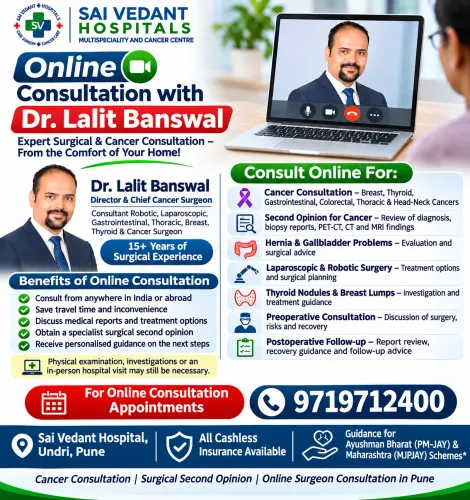
Dr Lalit Banswal can use this shared information to decide whether you need specialist pathology review, radiation or medical oncology input, or complex hepatopancreatobiliary surgery, while local cancer treatment in Baramati continues where appropriate. Keep one dated folder containing reports, prescriptions, operative notes and contact numbers; take it to every visit.
Each team should record what changed and who acts next.
Related service
Cancer Specialist In Pune Best Cancer Specialist in Pune Dr. Lalit Banswal is a highly experienced and renowned Cancer Specialist in Pune, known for his expertise in surgical... View service → |
What to track after surgery and when to seek urgent help
After surgery, follow-up must cover more than the incision. Review the final pathology report for tumour type, pathological stage, margin status, lymph-node findings and features that determine chemotherapy, radiation or other treatment. Track wound healing, drains, bowel or pancreatic-function changes, pain, neuropathy, nutrition, weight, rehabilitation and surveillance for recurrence.
Keep one shared treatment record in paper and digital form. Include the operation note, discharge summary, pathology and imaging reports, scan files, blood results, medicine doses, allergies, drain readings and every planned appointment. Ask the cancer surgeon in Baramati and the Pune specialist to update the same record after each review.
| Care location | Main follow-up role | Move or refer when |
|---|---|---|
| Baramati | Wound checks, drains, symptoms, nutrition and routine tests | Pathology review, complex complications or treatment planning needs specialist input |
| Pune | Specialist pathology, medical or radiation oncology, complex hepatopancreatobiliary care | Return local care with written instructions and a named contact |
Before discharge, obtain written answers to who responds after hours, which number to call and which emergency department to use. Do not wait for a routine appointment if you have:
- Fever, a red or draining wound, heavy bleeding or worsening abdominal pain or distension
- Repeated vomiting or inability to drink
- Breathlessness, confusion or rapidly increasing jaundice
Contact the treating team immediately; use emergency services for severe symptoms or rapid deterioration. Remote cancer treatment in Baramati is unsafe without this escalation plan.
Frequently asked questions
Who coordinates care after a cancer diagnosis?
The treating cancer team coordinates care, usually with a lead cancer surgeon working alongside medical and radiation oncologists.
How do you choose a cancer surgeon in Baramati?
Ask about the surgeon’s experience with your cancer, the hospital’s support services, and how they coordinate specialist surgery, pathology, chemotherapy, and radiation.
What should you take to the first post-diagnosis appointment?
Take biopsy and pathology reports, scan images and reports, blood-test results, medicine lists, previous illnesses, and written questions.
How can a cancer specialist in Pune support continuing care from Baramati?
A Pune specialist can review complex cases, plan advanced surgery, interpret specialist pathology, and coordinate chemotherapy or radiation with local follow-up.
What should you track after surgery?
Track temperature, wound changes, pain, vomiting, bowel or urine changes, eating, medicines, drains, and follow-up appointments.
Keywords