Gastroesophageal Cancer: Early Diagnosis Can Save Your Life
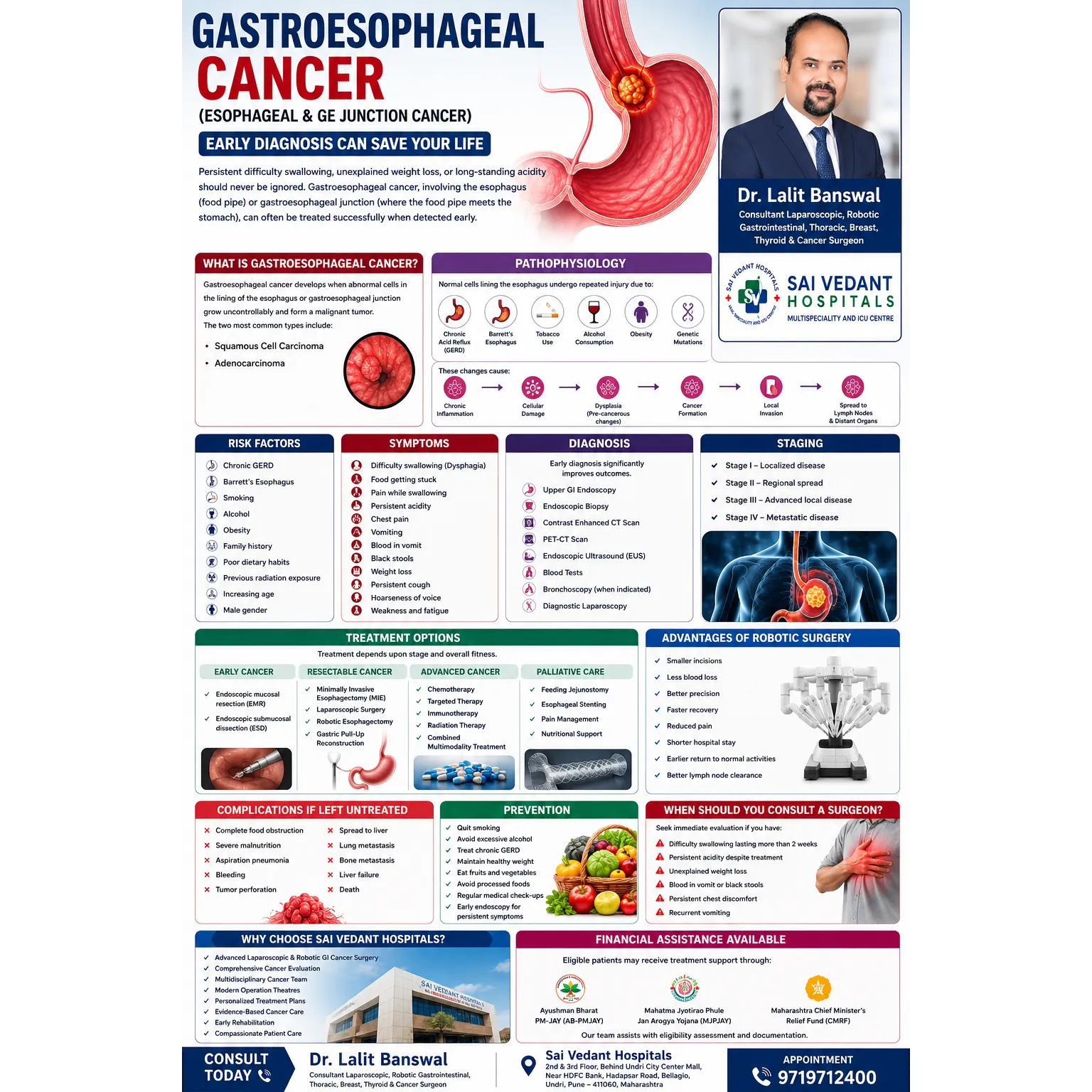
Persistent difficulty swallowing, unexplained weight loss, or long-standing acidity should never be ignored. Gastroesophageal cancer, involving the esophagus (food pipe) or gastroesophageal junction (where the food pipe meets the stomach), can often be treated successfully when detected early.
What is Gastroesophageal Cancer?
Gastroesophageal cancer develops when abnormal cells in the lining of the esophagus or gastroesophageal junction grow uncontrollably and form a malignant tumor.
The two most common types include:
Squamous Cell Carcinoma
Adenocarcinoma
Pathophysiology
Normal cells lining the esophagus undergo repeated injury due to:
Chronic acid reflux (GERD)
Barrett's Esophagus
Tobacco use
Alcohol consumption
Obesity
Genetic mutations
These changes cause:
➡ Chronic inflammation
➡ Cellular damage
➡ Dysplasia (pre-cancerous changes)
➡ Cancer formation
➡ Local invasion
➡ Spread to lymph nodes and distant organs
Risk Factors
✔ Chronic GERD
✔ Barrett's Esophagus
✔ Smoking
✔ Alcohol
✔ Obesity
✔ Family history
✔ Poor dietary habits
✔ Previous radiation exposure
✔ Increasing age
✔ Male gender
Symptoms
⚠ Difficulty swallowing (Dysphagia)
⚠ Food getting stuck
⚠ Pain while swallowing
⚠ Persistent acidity
⚠ Chest pain
⚠ Vomiting
⚠ Blood in vomit
⚠ Black stools
⚠ Weight loss
⚠ Persistent cough
⚠ Hoarseness of voice
⚠ Weakness and fatigue
Diagnosis
Early diagnosis significantly improves outcomes.
Investigations include:
✔ Upper GI Endoscopy
✔ Endoscopic Biopsy
✔ Contrast Enhanced CT Scan
✔ PET-CT Scan
✔ Endoscopic Ultrasound (EUS)
✔ Blood Tests
✔ Bronchoscopy (when indicated)
✔ Diagnostic Laparoscopy
Staging
Stage I – Localized disease
Stage II – Regional spread
Stage III – Advanced local disease
Stage IV – Metastatic disease
Treatment Options
Treatment depends upon stage and overall fitness.
Early Cancer
✅ Endoscopic mucosal resection (EMR)
✅ Endoscopic submucosal dissection (ESD)
Resectable Cancer
✅ Minimally Invasive Esophagectomy (MIE)
✅ Laparoscopic Surgery
✅ Robotic Esophagectomy
✅ Gastric Pull-Up Reconstruction
Advanced Cancer
✅ Chemotherapy
✅ Targeted Therapy
✅ Immunotherapy
✅ Radiation Therapy
✅ Combined Multimodality Treatment
Palliative Care
✔ Feeding Jejunostomy
✔ Esophageal Stenting
✔ Pain Management
✔ Nutritional Support
Advantages of Robotic Surgery
✔ Smaller incisions
✔ Less blood loss
✔ Better precision
✔ Faster recovery
✔ Reduced pain
✔ Shorter hospital stay
✔ Earlier return to normal activities
✔ Better lymph node clearance
Complications if Left Untreated
❌ Complete food obstruction
❌ Severe malnutrition
❌ Aspiration pneumonia
❌ Bleeding
❌ Tumor perforation
❌ Spread to liver
❌ Lung metastasis
❌ Bone metastasis
❌ Liver failure
❌ Death
Prevention
✔ Quit smoking
✔ Avoid excessive alcohol
✔ Treat chronic GERD
✔ Maintain healthy weight
✔ Eat fruits and vegetables
✔ Avoid processed foods
✔ Regular medical check-ups
✔ Early endoscopy for persistent symptoms
When Should You Consult a Surgeon?
Seek immediate evaluation if you have:
Difficulty swallowing lasting more than 2 weeks
Persistent acidity despite treatment
Unexplained weight loss
Blood in vomit or black stools
Persistent chest discomfort
Recurrent vomiting
Why Choose SaiVedant Hospital?
✅ Advanced Laparoscopic & Robotic GI Cancer Surgery
✅ Comprehensive Cancer Evaluation
✅ Multidisciplinary Cancer Team
✅ Modern Operation Theatres
✅ Personalized Treatment Plans
✅ Evidence-Based Cancer Care
✅ Early Rehabilitation
✅ Compassionate Patient Care
Financial Assistance Available
Eligible patients may receive treatment support through:
Ayushman Bharat PM-JAY (AB-PMJAY)
Mahatma Jyotirao Phule Jan Arogya Yojana (MJPJAY)
Maharashtra Chief Minister's Relief Fund (CMRF)
Our team assists with eligibility assessment and documentation.
Consult Today
Dr. Lalit Banswal
Consultant Laparoscopic, Robotic Gastrointestinal, Thoracic, Breast, Thyroid & Cancer Surgeon
🏥 SaiVedant Hospital
2nd & 3rd Floor, Behind Undri City Center Mall, Near HDFC Bank, Hadapsar Road, Bellagio, Undri, Pune – 411060, Maharashtra
📞 Appointment: 9719712400
Persistent difficulty swallowing, unexplained weight loss, or long-standing acidity should never be ignored. Gastroesophageal cancer, involving the esophagus (food pipe) or gastroesophageal junction (where the food pipe meets the stomach), can often be treated successfully when detected early.
What is Gastroesophageal Cancer?
Gastroesophageal cancer develops when abnormal cells in the lining of the esophagus or gastroesophageal junction grow uncontrollably and form a malignant tumor.
The two most common types include:
Squamous Cell Carcinoma
Adenocarcinoma
Pathophysiology
Normal cells lining the esophagus undergo repeated injury due to:
Chronic acid reflux (GERD)
Barrett's Esophagus
Tobacco use
Alcohol consumption
Obesity
Genetic mutations
These changes cause:
➡ Chronic inflammation
➡ Cellular damage
➡ Dysplasia (pre-cancerous changes)
➡ Cancer formation
➡ Local invasion
➡ Spread to lymph nodes and distant organs
Risk Factors
✔ Chronic GERD
✔ Barrett's Esophagus
✔ Smoking
✔ Alcohol
✔ Obesity
✔ Family history
✔ Poor dietary habits
✔ Previous radiation exposure
✔ Increasing age
✔ Male gender
Symptoms
⚠ Difficulty swallowing (Dysphagia)
⚠ Food getting stuck
⚠ Pain while swallowing
⚠ Persistent acidity
⚠ Chest pain
⚠ Vomiting
⚠ Blood in vomit
⚠ Black stools
⚠ Weight loss
⚠ Persistent cough
⚠ Hoarseness of voice
⚠ Weakness and fatigue
Diagnosis
Early diagnosis significantly improves outcomes.
Investigations include:
✔ Upper GI Endoscopy
✔ Endoscopic Biopsy
✔ Contrast Enhanced CT Scan
✔ PET-CT Scan
✔ Endoscopic Ultrasound (EUS)
✔ Blood Tests
✔ Bronchoscopy (when indicated)
✔ Diagnostic Laparoscopy
Staging
Stage I – Localized disease
Stage II – Regional spread
Stage III – Advanced local disease
Stage IV – Metastatic disease
Treatment Options
Treatment depends upon stage and overall fitness.
Early Cancer
✅ Endoscopic mucosal resection (EMR)
✅ Endoscopic submucosal dissection (ESD)
Resectable Cancer
✅ Minimally Invasive Esophagectomy (MIE)
✅ Laparoscopic Surgery
✅ Robotic Esophagectomy
✅ Gastric Pull-Up Reconstruction
Advanced Cancer
✅ Chemotherapy
✅ Targeted Therapy
✅ Immunotherapy
✅ Radiation Therapy
✅ Combined Multimodality Treatment
Palliative Care
✔ Feeding Jejunostomy
✔ Esophageal Stenting
✔ Pain Management
✔ Nutritional Support
Advantages of Robotic Surgery
✔ Smaller incisions
✔ Less blood loss
✔ Better precision
✔ Faster recovery
✔ Reduced pain
✔ Shorter hospital stay
✔ Earlier return to normal activities
✔ Better lymph node clearance
Complications if Left Untreated
❌ Complete food obstruction
❌ Severe malnutrition
❌ Aspiration pneumonia
❌ Bleeding
❌ Tumor perforation
❌ Spread to liver
❌ Lung metastasis
❌ Bone metastasis
❌ Liver failure
❌ Death
Prevention
✔ Quit smoking
✔ Avoid excessive alcohol
✔ Treat chronic GERD
✔ Maintain healthy weight
✔ Eat fruits and vegetables
✔ Avoid processed foods
✔ Regular medical check-ups
✔ Early endoscopy for persistent symptoms
When Should You Consult a Surgeon?
Seek immediate evaluation if you have:
Difficulty swallowing lasting more than 2 weeks
Persistent acidity despite treatment
Unexplained weight loss
Blood in vomit or black stools
Persistent chest discomfort
Recurrent vomiting
Why Choose SaiVedant Hospital?
✅ Advanced Laparoscopic & Robotic GI Cancer Surgery
✅ Comprehensive Cancer Evaluation
✅ Multidisciplinary Cancer Team
✅ Modern Operation Theatres
✅ Personalized Treatment Plans
✅ Evidence-Based Cancer Care
✅ Early Rehabilitation
✅ Compassionate Patient Care
Financial Assistance Available
Eligible patients may receive treatment support through:
Ayushman Bharat PM-JAY (AB-PMJAY)
Mahatma Jyotirao Phule Jan Arogya Yojana (MJPJAY)
Maharashtra Chief Minister's Relief Fund (CMRF)
Our team assists with eligibility assessment and documentation.
Consult Today
Dr. Lalit Banswal
Consultant Laparoscopic, Robotic Gastrointestinal, Thoracic, Breast, Thyroid & Cancer Surgeon
🏥 SaiVedant Hospital
2nd & 3rd Floor, Behind Undri City Center Mall, Near HDFC Bank, Hadapsar Road, Bellagio, Undri, Pune – 411060, Maharashtra
📞 Appointment: 9719712400
Keywords