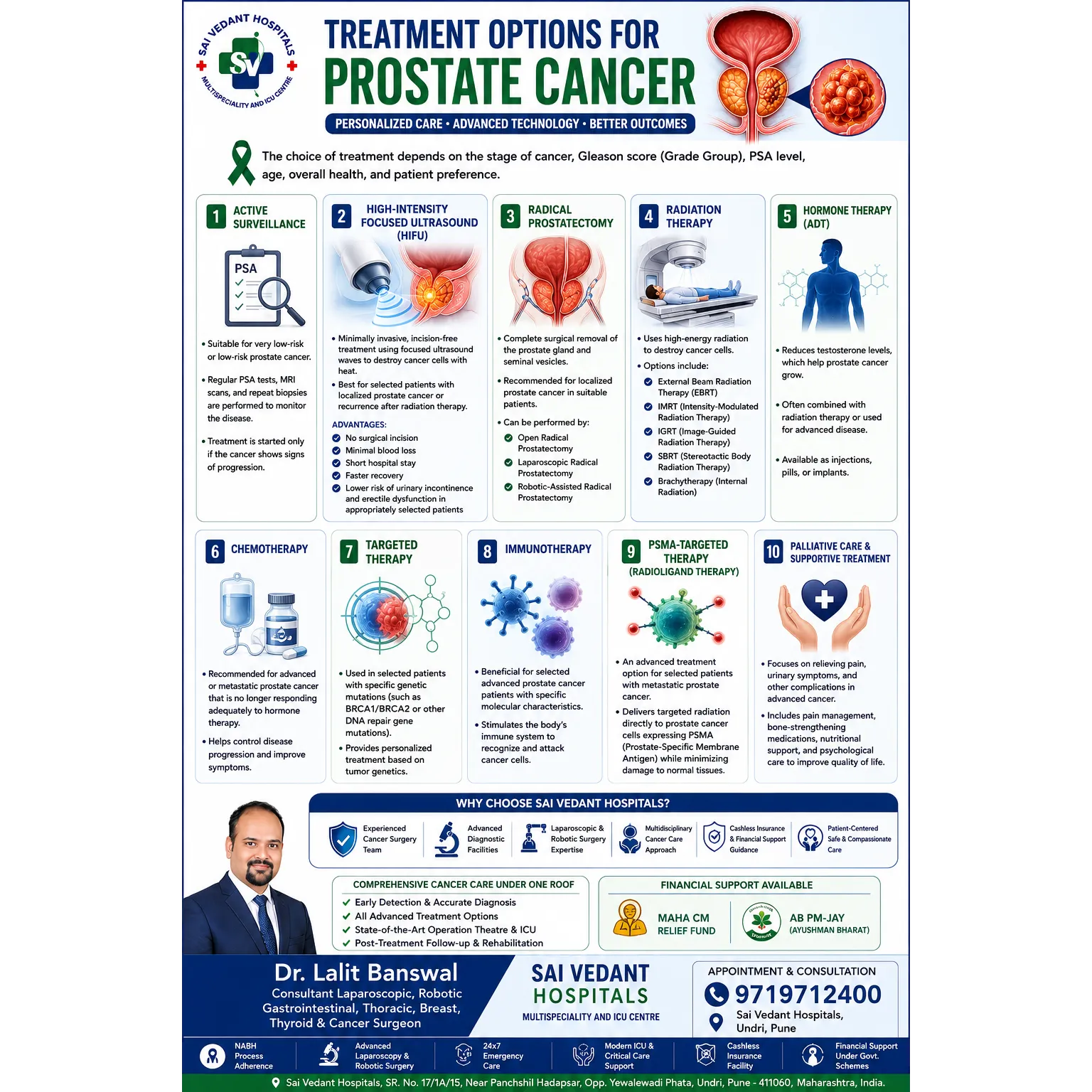
## 🩺 Treatment Options for Prostate Cancer
The choice of treatment depends on the **stage of cancer, Gleason score (Grade Group), PSA level, age, overall health, and patient preference.**
### ✅ Active Surveillance
* Suitable for very low-risk or low-risk prostate cancer.
* Regular PSA tests, MRI scans, and repeat biopsies are performed to monitor the disease.
* Treatment is started only if the cancer shows signs of progression.
### ✅ High-Intensity Focused Ultrasound (HIFU)
* A **minimally invasive, incision-free treatment** that uses focused ultrasound waves to destroy cancer cells with heat.
* Best suited for **selected patients with localized prostate cancer** or for recurrence after radiation therapy.
* Advantages include:
* No surgical incision
* Minimal blood loss
* Short hospital stay
* Faster recovery
* Lower risk of urinary incontinence and erectile dysfunction in appropriately selected patients
### ✅ Radical Prostatectomy
* Complete surgical removal of the prostate gland and seminal vesicles.
* Recommended for localized prostate cancer in suitable patients.
* Can be performed by:
* **Open Radical Prostatectomy**
* **Laparoscopic Radical Prostatectomy**
* **Robotic-Assisted Radical Prostatectomy**
### ✅ Radiation Therapy
* Uses high-energy radiation to destroy cancer cells.
* Options include:
* External Beam Radiation Therapy (EBRT)
* Intensity-Modulated Radiation Therapy (IMRT)
* Image-Guided Radiation Therapy (IGRT)
* Stereotactic Body Radiation Therapy (SBRT)
* Brachytherapy (Internal Radiation)
### ✅ Hormone Therapy (Androgen Deprivation Therapy – ADT)
* Reduces testosterone levels, which help prostate cancer grow.
* Often combined with radiation therapy or used for advanced disease.
### ✅ Chemotherapy
* Recommended for advanced or metastatic prostate cancer that is no longer responding adequately to hormone therapy.
* Helps control disease progression and improve symptoms.
### ✅ Targeted Therapy
* Used in selected patients with specific genetic mutations (such as **BRCA1/BRCA2** or other DNA repair gene mutations).
* Provides personalized treatment based on tumor genetics.
### ✅ Immunotherapy
* Beneficial for selected advanced prostate cancer patients with specific molecular characteristics.
* Stimulates the body's immune system to recognize and attack cancer cells.
### ✅ PSMA-Targeted Therapy (Radioligand Therapy)
* An advanced treatment option for selected patients with metastatic prostate cancer.
* Delivers targeted radiation directly to prostate cancer cells expressing **PSMA (Prostate-Specific Membrane Antigen)** while minimizing damage to normal tissues.
### ✅ Palliative Care & Supportive Treatment
* Focuses on relieving pain, urinary symptoms, and other complications in advanced cancer.
* Includes pain management, bone-strengthening medications, nutritional support, and psychological care to improve quality of life.
---
### 📍 Available Advanced Treatment Options
At **SaiVedant Hospital**, patients receive comprehensive evaluation and guidance regarding the most appropriate treatment options, including:
* HIFU (where appropriate and available through referral/associated services)
* Laparoscopic & Robotic Surgery
* Radiation Therapy Coordination
* Hormonal Therapy
* Chemotherapy
* Targeted Therapy
* Immunotherapy
* Multidisciplinary Cancer Care
**👨⚕️ Dr. Lalit Banswal**
*Consultant Laparoscopic, Robotic Gastrointestinal, Thoracic, Breast, Thyroid & Cancer Surgeon*
**🏥 SaiVedant Hospital, Undri, Pune**
**📞 Appointment: 9719712400**
The choice of treatment depends on the **stage of cancer, Gleason score (Grade Group), PSA level, age, overall health, and patient preference.**
### ✅ Active Surveillance
* Suitable for very low-risk or low-risk prostate cancer.
* Regular PSA tests, MRI scans, and repeat biopsies are performed to monitor the disease.
* Treatment is started only if the cancer shows signs of progression.
### ✅ High-Intensity Focused Ultrasound (HIFU)
* A **minimally invasive, incision-free treatment** that uses focused ultrasound waves to destroy cancer cells with heat.
* Best suited for **selected patients with localized prostate cancer** or for recurrence after radiation therapy.
* Advantages include:
* No surgical incision
* Minimal blood loss
* Short hospital stay
* Faster recovery
* Lower risk of urinary incontinence and erectile dysfunction in appropriately selected patients
### ✅ Radical Prostatectomy
* Complete surgical removal of the prostate gland and seminal vesicles.
* Recommended for localized prostate cancer in suitable patients.
* Can be performed by:
* **Open Radical Prostatectomy**
* **Laparoscopic Radical Prostatectomy**
* **Robotic-Assisted Radical Prostatectomy**
### ✅ Radiation Therapy
* Uses high-energy radiation to destroy cancer cells.
* Options include:
* External Beam Radiation Therapy (EBRT)
* Intensity-Modulated Radiation Therapy (IMRT)
* Image-Guided Radiation Therapy (IGRT)
* Stereotactic Body Radiation Therapy (SBRT)
* Brachytherapy (Internal Radiation)
### ✅ Hormone Therapy (Androgen Deprivation Therapy – ADT)
* Reduces testosterone levels, which help prostate cancer grow.
* Often combined with radiation therapy or used for advanced disease.
### ✅ Chemotherapy
* Recommended for advanced or metastatic prostate cancer that is no longer responding adequately to hormone therapy.
* Helps control disease progression and improve symptoms.
### ✅ Targeted Therapy
* Used in selected patients with specific genetic mutations (such as **BRCA1/BRCA2** or other DNA repair gene mutations).
* Provides personalized treatment based on tumor genetics.
### ✅ Immunotherapy
* Beneficial for selected advanced prostate cancer patients with specific molecular characteristics.
* Stimulates the body's immune system to recognize and attack cancer cells.
### ✅ PSMA-Targeted Therapy (Radioligand Therapy)
* An advanced treatment option for selected patients with metastatic prostate cancer.
* Delivers targeted radiation directly to prostate cancer cells expressing **PSMA (Prostate-Specific Membrane Antigen)** while minimizing damage to normal tissues.
### ✅ Palliative Care & Supportive Treatment
* Focuses on relieving pain, urinary symptoms, and other complications in advanced cancer.
* Includes pain management, bone-strengthening medications, nutritional support, and psychological care to improve quality of life.
---
### 📍 Available Advanced Treatment Options
At **SaiVedant Hospital**, patients receive comprehensive evaluation and guidance regarding the most appropriate treatment options, including:
* HIFU (where appropriate and available through referral/associated services)
* Laparoscopic & Robotic Surgery
* Radiation Therapy Coordination
* Hormonal Therapy
* Chemotherapy
* Targeted Therapy
* Immunotherapy
* Multidisciplinary Cancer Care
**👨⚕️ Dr. Lalit Banswal**
*Consultant Laparoscopic, Robotic Gastrointestinal, Thoracic, Breast, Thyroid & Cancer Surgeon*
**🏥 SaiVedant Hospital, Undri, Pune**
**📞 Appointment: 9719712400**
Keywords